Friday, September 16, 2011

Kansas Reptiles

Click on each animal to go to their list for Kansas!

Are Vertebrate animals. They have an internal bony skeleton.
Are cold-blooded. They cannot maintain their body temperature by internal means.
Have a dry, scaly skin or a shell.
Lay eggs with a tough outer shell, or have live birth. The eggs have an internal membrane called the amnion, which helps protect the developing embryo from injury and drying out. In some species of snakes, the eggs hatch internally and the young are born live.
Lay their eggs on land.

Have claws on their toes (excepting snakes).

Currently, there are about 6,500 recognized species of reptiles in the world, divided into 5 living orders. Within Kansas 67 species are recorded from 16 families in 2 orders.

Classification of living organisms has undergone a profound revolution within the last thirty years due to the advent of DNA analysis and the new taxonomic discipline of cladistics, which does not necessarily use the classical Linnean hierarchy (Kingdom-Phylum-Class-Order-Family-Genus-Species) to sort out how creatures are related to each other. The position of turtles, for instance, is a contentious issue currently. For more information, see the link to the Tree of Life website in the resource list.

The species list below is based on "A Checklist of the Vertebrate Animals of Kansas", 3rd edition, 2005, by George Potts and Joseph Collins. This publication is available from the Kansas University Natural History Museum, 1345 Jayhawk Blvd., Lawrence, KS 66045-7163.

For a pdf version of the Kansas list, click here Kansas turtles & reptiles list.
(On a Windows system, download the file by right clicking on the link and choose "Save Target As" to save it to your hard drive, then open it from there. You will need Acrobat Reader to view this file. If you don't have that software already, you can get it for free from Adobe.)
In this list, the scientific name of each species follows the common name and is written in italics.

There is a species portrait page done for the Ornate Box Turtle.
Range maps and population status for the seven reptile species on the Kansas Threatened & Endangered Species list may be found in the Kansas Wildlife Refuge.
Basic information on all Kansas snakes may be found within the Snake's Burrow!


Lizards
(15 Species in Kansas)


Family Crotaphytidae - Collared Lizards Eastern Collared Lizard - Crotaphytus collaris

Family Phrynosomatidae - Prairie, Earless & Horned Lizards Lesser Earless Lizard - Holbrookia maculata
Texas Horned Lizard - Phrynosoma cornutum
Prairie Lizard - Sceloporus consobrinus

Family Scincidae - Skinks Coal Skink - Eumeces anthracinus
Five-lined Skink - Eumeces fasciatus
Broadhead Skink - Eumeces laticeps
Great Plains Skink - Eumeces obsoletus Southern Prairie Skink - Eumeces obtusirostris
Northern Prairie Skink - Eumeces septentrionalis
Ground Skink - Scincella lateralis

Family Lacertidae - Wall Lizards Western Green Lacerta - Lacerta bilineata
Italian Wall Lizard - Podarcis sicula

Family Teiidae - Whiptails Six-lined Racerunner - Aspidoscelis sexlineata

Family Anguidae - Glass Lizards Western Slender Glass Lizard - Ophisaurus attenuatus

Snakes(38 Species in Kansas)

Family Leptotyphlopidae - Slender Blind Snakes New Mexico Blind Snake - Leptotyphlops dissectis

Family Colubridae - Harmless Egg-laying Snakes Eastern Glossy Snake - Arizona elegans
Eastern Racer - Coluber constrictor
Prairie Kingsnake - Lampropeltis calligaster
Common Kingsnake - Lampropeltis getula
Milk Snake - Lampropeltis triangulum
Coachwhip - Masticophis flagellum
Rough Green Snake - Opheodrys aestivus
Great Plains Rat Snake - Pantherophis emoryi
Western Rat Snake - Pantherophis obsoletus
Gopher Snake - Pituophis catenifer
Longnose Snake - Rhinocheilus lecontei
Ground Snake - Sonora semiannulata
Flathead Snake - Tantilla gracilis
Plains Blackhead Snake - Tantilla nigriceps

Family Dipsadidae - Slender Rear-fanged Snakes Western Worm Snake - Carphophis vermis
Ringneck Snake - Diadophis punctatus Night Snake - Hypsiglena torquata

Family Natricidae - Harmless Live-bearing Snakes
Plainbelly Water Snake - Nerodia erythrogaster
Diamondback Water Snake - Nerodia rhombifer
Northern Water Snake - Nerodia sipedon Graham's Crayfish Snake - Regina grahamii
Brown Snake - Storeria dekayi
Redbelly Snake - Storeria occipitomaculata
Checkered Garter Snake - Thamnophis marcianus
Western Ribbon Snake - Thamnophis proximus
Plains Garter Snake - Thamnophis radix
Common Garter Snake - Thamnophis sirtalis
Lined Snake - Tropidoclonion lineatum
Rough Earth Snake - Virginia striatula
Smooth Earth Snake - Virginia valeriae

Family Xenodontidae - Robust Rear-fanged Snakes
Western Hognose Snake - Heterodon nasicus
Eastern Hognose Snake - Heterodon platirhinos

Family Crotalidae - Pit Vipers Copperhead - Agkistrodon contortrix
Cottonmouth - Agkistrodon piscivorus
Timber Rattlesnake - Crotalus horridus
Prairie Rattlesnake - Crotalus viridis
Massasauga - Sistrurus catenatus

Turtles
(15 Species in Kansas)


Family Chelydridae - Snapping Turtles
Common Snapping Turtle Chelydra serpentina
Alligator Snapping Turtle - Macrochelys temminckii

Family Kinosternidae - Mud & Musk Turtles Yellow Mud Turtle - Kinosternon flavescens
Common Musk Turtle - Sternotherus odoratus

Family Emydidae - Box & Basking Turtles
Northern Painted Turtle - Chrysemys picta
Common Map Turtle - Graptemys geographica
Ouachita Map Turtle - Graptemys ouachitensis
False Map Turtle - Graptemys pseudogeographica
River Cooter - Pseudemys concinna
Eastern Box Turtle - Terrapene carolina
Ornate Box Turtle - Terrapene ornata
Pond Slider - Trachemys scripta

Family Trionychidae - Softshell Turtles Smooth Softshell - Apalone mutica
Spiny Softshell - Apalone spinifera


For more information on reptiles, see these resources:


For detailed information on the distribution of reptiles in Kansas,
visit the Kansas Herpetofaunal Atlas.
If you have a strong interest in Great Plains reptiles, you may wish to join
the Kansas Herpetological Society.
An alternate taxonomy for Kansas reptiles may be found in the "Scientific and Standard English Names of Amphibians and Reptiles of North America North of Mexico" by the Society for the Study of Amphibians and Reptiles. This paper is available for download here.
Visit the Tree of Life website to see how cladistic analysis presents the classification of animals.

A Kansas Reptile Trip

This video was made by J. Kobylka Reptiles. Hope you enjoy!

Thursday, September 15, 2011

Burning Down the Forest to Restore the Collared Lizard

The introduction of firefighting after WWII to the Ozark Glades diminished collared lizard populations

By John B. Virata
September 1, 2011


Click image for infographic
The collared lizard grows to 10-16 inches in length. Its range includes Mexico and the southwestern U.S. and extends into the midwestern U.S.
A 20 year study led by a professor of biology in Arts & Sciences at Washington University in St. Louis concludes that the Eastern collared lizard (Crotaphytus collaris collaris) can restore its populations with little help from biologists after a burn technique called landscape-level burning on Ozark glades, its natural habitat. The study by Alan R. Templeton, PhD, states that the collared lizard undertakes an expanded restoration on its own after a burn that also benefits other species, including the fen orchid and fen dragonfly, with little assistance from biologists.
In 1982, Templeton and colleagues did a survey of the Ozarks and concluded that 75 percent of the lizard populations were gone, and in other areas the lizard was known to populate, it was extinct. The scientists determined that the introduction of firefighting after World War II led to an explosion of the Eastern red cedar tree, a species that was confined to the bluffs and cliffs of the Ozarks prior to the advent of forest firefighting. When man decided to fight forest fires in the area, the red cedar grew unabated, affecting the habitat of the collared lizard by effectively shading out the areas in which the lizard lived, turning what was once a sunny and sparse, hot, desert-like micro-climate to an area thick with vegetation.
In the mid 1980s, Templeton worked on restoring areas of the Ozark glades, which involved removing the red cedar trees and burning the areas. The restoration was a success and the plants that were native to the areas prior to the invasion of the giant tree canopies returned. He reintroduced the lizard over the course of several years in the mid to late 1980s, but in 1993 determined that the lizard was not faring well and the small populations would collapse due to dense underbrush that hampered the lizard’s ability to travel. To the dismay of foresters and environmentalists, a landscape level burn was recommended, and after two years of heated discussions, the burn took place.
“We did the burn and to tell the truth, I wasn’t really very optimistic about it,” Templeton told the Washington University in St. Louis newspaper. “I thought it was more really to reduce the fuel load, but I was stunned by what it did. Just one burn totally changed the environment. All of us were just shocked at how beneficial it was. “The fire mainly got rid of the woody understory and thick mats of leaf litter, but it didn’t destroy the canopy trees. In fact, with the woody understory gone, the canopy trees grew better, so the forestry people were happy. “The woody understory was mostly exotics, little shrubby trees that came from elsewhere. Once they were gone, the nutrients were released into the soil, and the soil was exposed to more sunlight, the endemics came back. All these endemic herbaceous plants came out of the forest floor and with them came a very abundant insect community. So the environmentalists were happy, too."
The burn essentially gave the lizard the opportunity to move about. Templeton introduced the lizards on three glades in the Ozarks, and on their own, they've populated 140 more glades. While glade size important, equally important is orientation, as the lizards fare better in a glade facing southwest. "Our glade sizes varied from 498 square meters to 45,373 m^2," Templeton told ReptileChannel.  "Our paper gives the details on dispersal distances, with adult females generally going to the nearest glade, with an average of moving 147 meters. In contrast, hatchlings moved an average of 647 meters when they dispersed."  The population of the lizard on the glades varied, from 1 to 58 lizards, not counting hatchlings, with 12 lizards being the average.
The collared lizard grows to 10-16 inches in length. Its range includes Mexico and the southwestern U.S. and extends into the midwestern U.S. In addition to the glades of the Ozarks, it can be found in a range of conditions, from grassy meadows and hillsides to rocky outcroppings and deserts.

http://www.reptilechannel.com/reptile-news/2011/09/01/collared-lizard-restored-by-fire.aspx

Wednesday, September 14, 2011

How to Become a Herpetologist

 I hope you enjoy the video! By the way this is not me!

Tuesday, September 13, 2011

Reptile Vocabulary

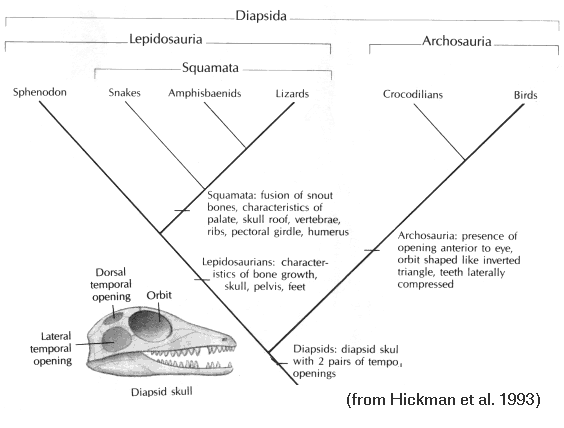
Reptilia cladogramhttp://www.enchantedlearning.com/subjects/reptiles/printouts.shtml

 Diapsid  n. Any of various reptiles having a skull with two pairs of temporal openings and including the lizards, snakes, crocodiles, dinosaurs, and pterosaurs.


Read more: http://www.answers.com/topic/diapsid#ixzz1Xrb3ZUNE

http://www.mun.ca/biology/scarr/Diapsida_phylogeny.gif

Baby Collared Lizards

Here is a video that follows up on the post yesterday. Hope you enjoy!

Monday, September 12, 2011

The Collared Lizard

Common collared lizard

From Wikipedia, the free encyclopedia
(Redirected from Common Collared Lizard)
Jump to: navigation, search
Common collared lizard
A common collared lizard in Black Canyon of the Gunnison National Park
Scientific classification
Kingdom:Animalia
Phylum:Chordata
Class:Reptilia
Order:Squamata
Suborder:Iguania
Family:Crotaphytidae
Genus:Crotaphytus
Species:C. collaris
Binomial name
Crotaphytus collaris
(Say, 1823)
The Common collared lizard, Oklahoma collared lizard or collared lizard, Crotaphytus collaris, is a North American lizard that can reach a foot (30 cm) long in length (including the tail), with a large head and powerful jaws. They are well known for the ability to run on their hind legs, looking like small dinosaurs. The collared lizard is the state reptile of the United States state of Oklahoma, where it is known as the Mountain Boomer. The name "collared lizard" comes from the lizards' distinct coloration, which includes bands of black around the neck and shoulders that look like a collar. It is a member of the collared lizard family.
These reptiles are often tamed and kept as pets. When born in captivity, they are quite docile and tolerant of interaction with humans. They are very active and predatory lizards, requiring a large amount of space to run. They prefer high temperatures, up to 105-110°F (40-43°C) at their basking spot and 80°F (26°C) elsewhere in their habitat during the day. Some collared lizards eat small amounts of fruit or vegetables, but most prefer a diet of insects. They will also consume vertebrate prey, including small mammals and other lizards. Like many reptiles, in captivity they must be provided a diet supplemented with extra calcium and a light source with a UVB radiation to reduce the risk of bone disorders.

Collared lizard in Zion National Park, Utah

The origin of the name "mountain boomer" is not clear, but it may date back to settlers travelling west during the Gold Rush. One theory is that settlers mistook the sound of wind in canyons for the call of an animal in an area where the collared lizard was abundant. In reality, collared lizards are silent.
Like many other lizards, including the frilled lizard and basilisk, collared lizards can run on their hind legs, and are relatively fast sprinters. Record speeds have been around 16 miles/hour (26 km/h), much slower than the world record for lizards (21.5 miles/h or 34.6 km/h) attained by the larger-bodied Costa Rica spiny-tailed iguana, Ctenosaura similis.
Male Collared Lizard with blue-green body and yellow-brown head.
Male Common Collared Lizard at the Wichita Mountains Wildlife Refuge near Lawton, Oklahoma.

Collared lizards in the wild have been the subject of a number of studies of sexual selection. In captivity if two males are placed in the same cage they will fight to the death. This is not only in captivity though for it will fight if any other male is in its presence. Females will not fight though because just like many other animals in the animal kingdom the males fight to get the females' attention. Then they will try to kill the other male to win the female over. Males have a blue-green body with a light brown head. Females have a light brown head and body.

[edit] References

  • Bonine, K. E., and T. Garland, Jr. 1999. Sprint performance of phrynosomatid lizards, measured on a high-speed treadmill, correlates with hindlimb length. Journal of Zoology, London 248:255-265. PDF
  • Garland, T., Jr. 1984. Physiological correlates of locomotory performance in a lizard: an allometric approach. Am. J. Physiol. 247 (Regulatory Integrative Comp. Physiol. 16):R806-R815. PDF
  • Husak, J. F., and S. F. Fox. 2006. Field use of maximal sprint speed by collared lizards (Crotaphytus collaris): compensation and sexual selection. Evolution 60:1888-1895.
  • Husak, J. F., Fox, S. F, Lovern, M. B., and Van Den Bussche, R. A. 2006. Faster lizards sire more offspring: sexual selection on whole-animal performance. Evolution 60:2122-2130.
  • Lappin, A. K., Y. Brandt, J. F. Husak, J. M. Macedonia, and D. J. Kemp. 2005. Gaping displays reveal and amplify a mechanically based index of weapon performance. American Naturalist 168:100-113.
  • Snyder, R. C. 1962. Adaptations for bipedal locomotion of lizards. Am. Zool. 2:191-203.
  • Drake E.C. 1999 Information on the Collared Lizard.
GOT FROM: http://en.wikipedia.org/wiki/Common_Collared_Lizard